
- Home
- Browse Businesses
- Categories
- E-commerce
-
-
-
E-commerce
-
-
-
- SaaS
-
-
-
SaaS
-
-
-
- Digital Agencies
-
-
-
Digital Agencies
AI Automation Agency456 Listings
Content Marketing Agency213 Listings
Digital Marketing Agency134 Listings
-
-
-
- Website
-
Websites
-
- Apps & Software
-
Apps & Software
-
- AI Businesses
-
AI Businesses
-
- Other Online Businesses
-
Other Online Businesses
Data & Information Business256 Listings
Digital Asset Business213 Listings
Licensing Business234 Listings
-
- Marketplace
-
Marketplace
-
- Digital Products
-
Digital Products
-
- Domains & Digital Assets
-
Domains & Digital Assets
Data & Information Asset156 Listings
Digital Asset Portfolio113 Listings
Domain Portfolio234 Listings
Other Digital Asset187 Listings
Single Premium Domain198 Listings
-
- Crypto & Blockchain
-
Crypto & Blockchain
Blockchain Software Business156 Listings
Crypto Data & Analytics Business113 Listings
Crypto Media Business234 Listings
NFT Platform or Marketplace187 Listings
Other Crypto & Blockchain Business198 Listings
Web3 Business34 Listings
-
- Online Services
-
Online Services
Lead Generation Business456 Listings
Managed Online Service213 Listings
Online Coaching Business134 Listings
Other Online Service287 Listings
Subscription Service98 Listings
Remote Service Business62 Listings
-
- Content & Media
-
Content & Media
-
- E-commerce
- Pricing
- About
- FAQ
- Contact
- My account
BUYER’S GUIDE
The Complete Guide to Buying an Online Business
Looking to acquire an online business? This guide walks you through the key steps to finding, evaluating and acquiring an online business on Wynsell — from your initial search to due diligence and the final transfer.
Free Buyer’s Guide
Practical Buying Tips
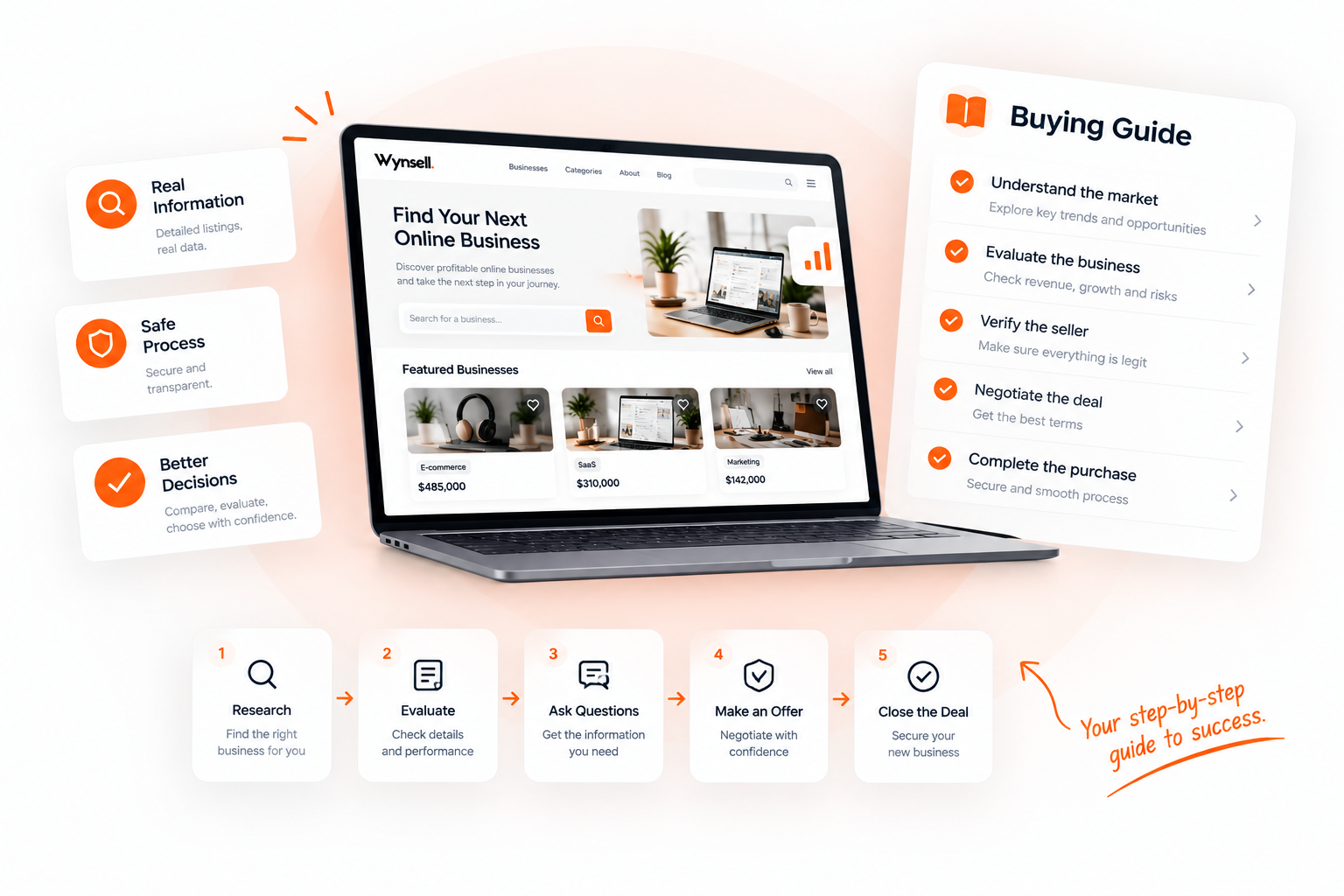
7 Steps to Buying an Online Business
Follow these key steps to evaluate an opportunity and make a more informed acquisition decision.
1
Define Your Goals
Determine your budget, experience, interests and the type of online business you’re looking for.
2
Find the Right Business
Browse online businesses that match your criteria on Wynsell.
3
Evaluate the Opportunity
Review the business model, financial performance, traffic, customers, operations and growth potential.
4
Conduct Due Diligence
Verify the financial, operational, legal and technical information provided by the seller.
5
Negotiate the Deal
Discuss the purchase price, deal structure, included assets and transition terms directly with the seller.
6
Arrange Payment & Agreements
Agree on the appropriate legal documentation and payment process with the seller.
7
Complete the Transfer
Finalize the acquisition and transfer the business assets, accounts and operational access.
THE DETAILS OF EACH STEP
Before searching for an online business, define what you’re looking for. Consider your budget, experience, available time, preferred business model and investment goals.
You may be interested in an e-commerce brand, SaaS company, website, app, digital agency, AI business, marketplace or another type of online business.
Think beyond the purchase price. Consider how involved you want to be in day-to-day operations, whether the business requires specialized skills, and what level of risk you’re comfortable with.
Use Wynsell to explore online businesses for sale and compare opportunities based on the criteria that matter to you.
Review factors such as the asking price, annual revenue, annual profit, business age, business model, location or primary market, and the information provided by the seller.
When an opportunity interests you, contact the seller directly through Wynsell to learn more about the business.
Before making an offer, take time to understand how the business actually works.
Review its revenue and profit history, operating expenses, customer acquisition channels, traffic sources, recurring revenue, customer concentration, supplier relationships, workload and growth opportunities.
For an e-commerce business, for example, you may want to understand inventory, suppliers, advertising performance and customer acquisition costs.
For a SaaS business, recurring revenue, churn, customer concentration and technology should receive particular attention.
The objective is not simply to find a profitable business, but to understand how that profit is generated and whether it can reasonably continue after the acquisition.
Due diligence is one of the most important stages of acquiring an online business.
Don’t rely solely on the information displayed in the listing. Ask the seller for supporting documentation and independently verify the information relevant to the acquisition.
Depending on the business, this may include:
Financial records · Bank or payment processor statements · Analytics data · Advertising accounts · Customer data · Supplier agreements · Intellectual property · Domain ownership · Software and source code · Contracts · Liabilities
For larger or more complex acquisitions, consider working with qualified legal, accounting, financial or technical professionals.
Cette partie est très importante pour Wynsell : la marketplace ne doit pas donner l’impression qu’elle effectue la due diligence à la place de l’acheteur.
Once you’ve evaluated the business and completed the necessary checks, you can negotiate directly with the seller.
The negotiation may cover more than the asking price. Consider what assets are included, payment terms, inventory, intellectual property, seller support after the acquisition, transition period and any other conditions important to the transaction.
Make sure the final agreement clearly defines what is being transferred.
Once you and the seller agree on the main terms, determine how the transaction will be documented and completed.
Depending on the size and complexity of the acquisition, consider obtaining appropriate legal and financial advice and using a suitable payment or escrow solution.
Wynsell connects buyers and sellers but does not itself act as the buyer, seller, broker or escrow provider.
The final step is transferring control of the business.
Depending on the business, this may include domains, websites, e-commerce stores, software, source code, social media accounts, advertising accounts, email systems, intellectual property, customer relationships, supplier accounts and other digital assets.
Create a clear transfer checklist with the seller and confirm that all agreed assets and access have been transferred.
Where appropriate, agree on a transition period during which the seller can help you understand the business operations.
Smart Tips Before You Buy
Verify the Numbers
Don’t rely solely on the listing. Request supporting evidence and independently verify key financial and operational information.
Understand the Business
Know how the business generates revenue, attracts customers and operates before you buy.
Look Beyond the Asking Price
Evaluate profitability, sustainability, risks, workload and growth potential — not just the purchase price.
Plan the Transition
Know exactly what will be transferred and how the business will operate after the acquisition.
📊
Find Your Next Online Business
Explore online businesses for sale and connect directly with sellers on Wynsell.
FREQUENTLY ASKED QUESTIONS
The purchase price of an online business can vary significantly depending on its revenue, profit, growth, business model, age, customer base, operational requirements and other factors.
Always evaluate the underlying business and conduct appropriate due diligence before making an acquisition decision.
Review and verify the business’s financial performance, traffic, customer acquisition, operating expenses, assets, liabilities, contracts, intellectual property and any other information relevant to the acquisition.
The exact due diligence required will depend on the type of business.
Yes. Wynsell is designed to connect buyers and sellers directly so they can ask questions, exchange information and discuss a potential transaction.
For significant or complex acquisitions, consider consulting qualified legal, accounting, financial or technical professionals where appropriate.
Verification may vary by listing. Buyers should independently verify all material information and conduct their own due diligence before completing an acquisition.
Wynsell does not charge buyers a commission based on the final sale price.
No. Wynsell connects buyers and sellers but does not process or hold the purchase price for the acquisition. Buyers and sellers are responsible for agreeing on an appropriate transaction and payment process.
There is no standard timeframe. The process depends on the complexity of the business, the amount of due diligence required, negotiations, legal documentation and the transfer process.
Online Businesses Only
A marketplace dedicated to digital and online businesses.
Direct Seller Contact
Connect and communicate directly with business owners.
Confidential Listings
Sellers can protect sensitive business information.
Independent Due Diligence
Review and verify the information before completing an acquisition.